Hi! I'm Yuan Yin 银元
AI Researcher at Valeo.ai
My research focuses on machine learning and deep learning for spatiotemporal sequence modeling, simulation, prediction, and analysis of complex behaviors. I also explore methods to extend the generalization of data-driven models, particularly through model adaptation.
I defended my PhD in June 2023 at Sorbonne Université, under the supervision of Prof. Patrick Gallinari and Assoc. Prof. Nicolas Baskiotis. Before that, I obtained my BSc in Computer Science from Beihang University in 2016, followed by an MSc in Computer Science from Université Paris Cité (M1 MPRI) and Sorbonne Université (M2 DAC) in 2018-2019.
Latest update
- Lounès Meddahi started as my PhD student with Sorbonne Université, ISIR, MLIA Team.
- DrivoR, a paper I co-authored, has been accepted to CVPR 2026.
- PPT has been accepted to ICRA 2026.
- IPA has been selected for Best Paper Award at the NeurIPS 2025 CCFM Workshop.
- IPA has been accepted to TMLR as is.
- IPA has been accepted as an oral presentation to the NeurIPS 2025 CCFM Workshop.
Selected publications
- Conference CVPRDriving on RegistersEllington Kirby, Alexandre Boulch, Yihong Xu, Yuan Yin, Gilles Puy, Éloi Zablocki, Andrei Bursuc, Spyros Gidaris, Renaud Marlet, Florent Bartoccioni, Anh-Quan Cao, Nermin Samet, Tuan-Hung VU, and Matthieu CordIn Proceedings of the IEEE/CVF Conference on Computer Vision and Pattern Recognition, Jun 2026
We present DrivoR, a simple and efficient transformer-based architecture for end-to-end autonomous driving. Our approach builds on pretrained Vision Transformers (ViTs) and introduces camera-aware register tokens that compress multi-camera features into a compact scene representation, significantly reducing downstream computation without sacrificing accuracy. These tokens drive two lightweight transformer decoders that generate and then score candidate trajectories. The scoring decoder learns to mimic an oracle and predicts interpretable sub-scores representing aspects such as safety, comfort, and efficiency, enabling behavior-conditioned driving at inference. Despite its minimal design, DrivoR outperforms or matches strong contemporary baselines across NAVSIM-v1, NAVSIM-v2, and the photorealistic closed-loop HUGSIM benchmark. Our results show that a pure-transformer architecture, combined with targeted token compression, is sufficient for accurate, efficient, and adaptive end-to-end driving. Code and checkpoints will be made available.
- Journal TMLR + Workshop NeurIPS CCFMIPA: An Information-Reconstructive Input Projection Framework for Efficient Foundation Model AdaptationTransactions on Machine Learning Research, Sep 2025
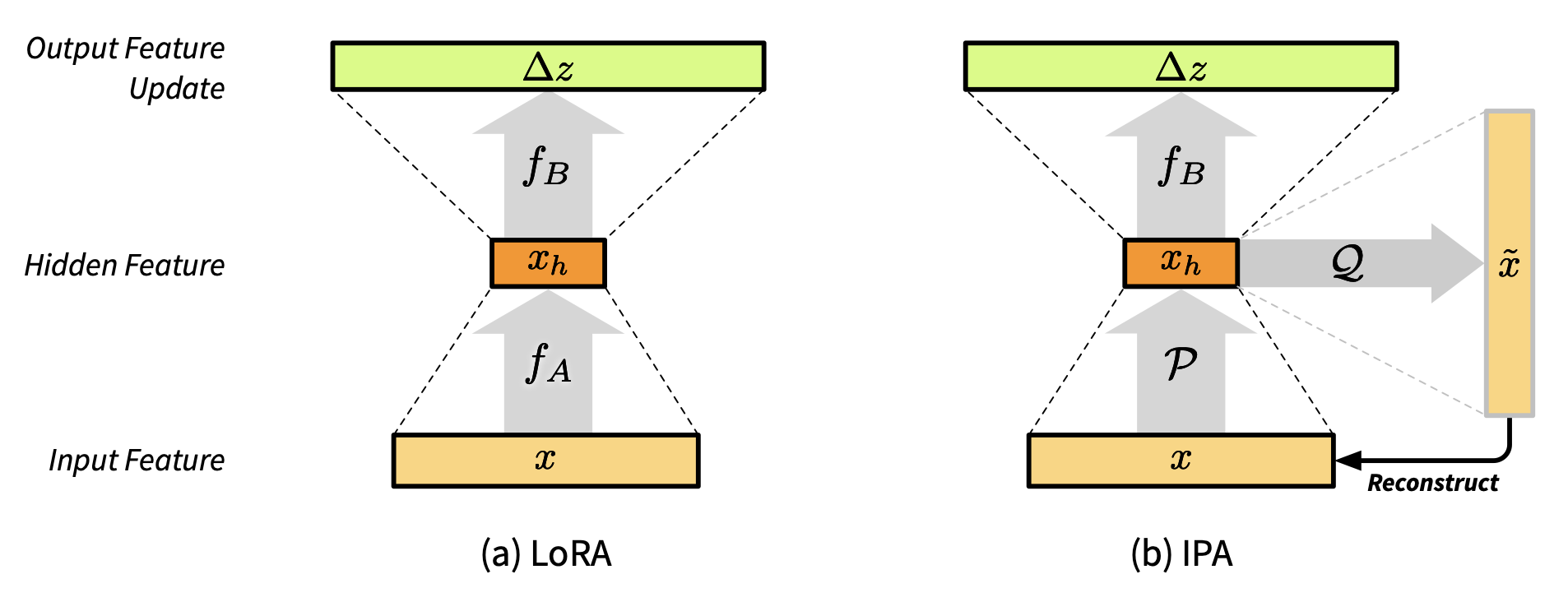
IPA received the Best Paper Award at NeurIPS 2025 CCFM Workshop.
Parameter-efficient fine-tuning (PEFT) methods, such as LoRA, reduce adaptation cost by injecting low-rank updates into pretrained weights. However, LoRA’s down-projection is randomly initialized and data-agnostic, discarding potentially useful information. Prior analyses show that this projection changes little during training, while the up-projection carries most of the adaptation, making the random input compression a performance bottleneck. We propose IPA, a feature-aware projection framework that explicitly preserves information in the reduced hidden space. In the linear case, we instantiate IPA with algorithms approximating top principal components, enabling efficient projector pretraining with negligible inference overhead. Across language and vision benchmarks, IPA consistently improves over LoRA and DoRA, achieving on average 1.5 points higher accuracy on commonsense reasoning and 2.3 points on VTAB-1k, while matching full LoRA performance with roughly half the trainable parameters when the projection is frozen.
- Conference NeurIPSGEPS: Boosting Generalization in Parametric PDE Neural Solvers through Adaptive ConditioningIn The Thirty-eighth Annual Conference on Neural Information Processing Systems, Dec 2024
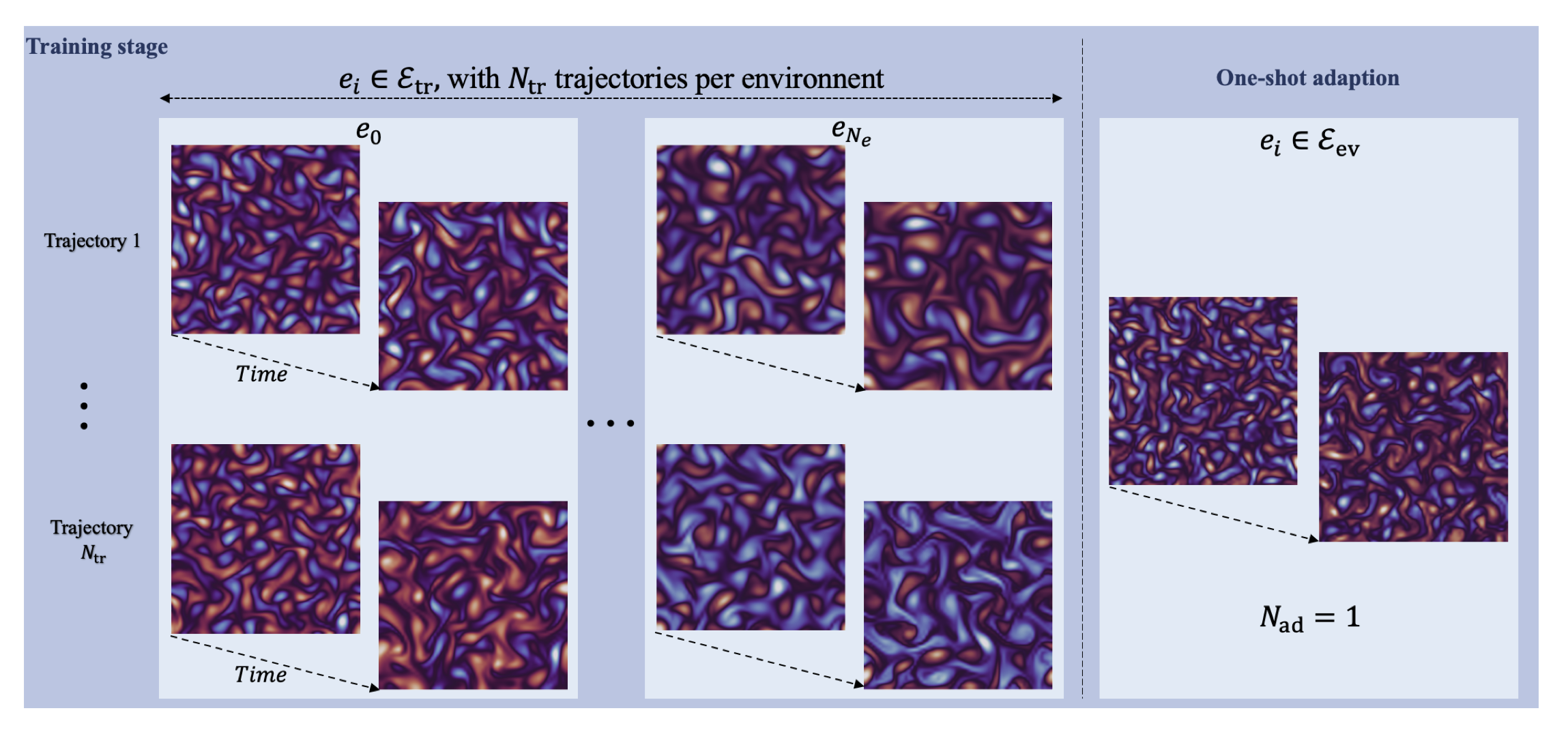
Solving parametric partial differential equations (PDEs) presents significant challenges for data-driven methods due to the sensitivity of spatio-temporal dynamics to variations in PDE parameters. Machine learning approaches often struggle to capture this variability. To address this, data-driven approaches learn parametric PDEs by sampling a very large variety of trajectories with varying PDE parameters. We first show that incorporating conditioning mechanisms for learning parametric PDEs is essential and that among them, adaptive conditioning, allows stronger generalization. As existing adaptive conditioning methods do not scale well with respect to the number of parameters to adapt in the neural solver, we propose GEPS, a simple adaptation mechanism to boost GEneralization in Pde Solvers via a first-order optimization and low-rank rapid adaptation of a small set of context parameters. We demonstrate the versatility of our approach for both fully data-driven and for physics-aware neural solvers. Validation performed on a whole range of spatio-temporal forecasting problems demonstrates excellent performance for generalizing to unseen conditions including initial conditions, PDE coefficients, forcing terms and solution domain.
- Workshop ECCV W-CODAReGentS: Real-World Safety-Critical Driving Scenario Generation Made StableIn ECCV 2024 Workshop on Multimodal Perception and Comprehension of Corner Cases in Autonomous Driving, Sep 2024
Machine learning based autonomous driving systems often face challenges with safety-critical scenarios that are rare in real-world data, hindering their large-scale deployment. While increasing real-world training data coverage could address this issue, it is costly and dangerous. This work explores generating safety-critical driving scenarios by modifying complex real-world regular scenarios through trajectory optimization. We propose ReGentS, which stabilizes generated trajectories and introduces heuristics to avoid obvious collisions and optimization problems. Our approach addresses unrealistic diverging trajectories and unavoidable collision scenarios that are not useful for training robust planner. We also extend the scenario generation framework to handle real-world data with up to 32 agents. Additionally, by using a differentiable simulator, our approach simplifies gradient descent-based optimization involving a simulator, paving the way for future advancements.
- Conference ICLRLearning a Neural Solver for Parametric PDE to Enhance Physics-Informed MethodsLise Le Boudec, Emmanuel de Bézenac, Louis Serrano, Ramón Daniel Regueiro Espiño, Yuan Yin, and Patrick GallinariIn The Thirteenth International Conference on Learning Representations, May 2025
Physics-informed deep learning often faces optimization challenges due to the complexity of solving partial differential equations (PDEs), which involve exploring large solution spaces, require numerous iterations, and can lead to unstable training. These challenges arise particularly from the ill-conditioning of the optimization problem, caused by the differential terms in the loss function. To address these issues, we propose learning a solver, i.e., solving PDEs using a physics-informed iterative algorithm trained on data. Our method learns to condition a gradient descent algorithm that automatically adapts to each PDE instance, significantly accelerating and stabilizing the optimization process and enabling faster convergence of physics-aware models. Furthermore, while traditional physics-informed methods solve for a single PDE instance, our approach addresses parametric PDEs. Specifically, our method integrates the physical loss gradient with the PDE parameters to solve over a distribution of PDE parameters, including coefficients, initial conditions, or boundary conditions. We demonstrate the effectiveness of our method through empirical experiments on multiple datasets, comparing training and test-time optimization performance.
- Conference ICRAPPT: Pre-Training with Pseudo-Labeled Trajectories for Motion ForecastingIn The 2026 IEEE International Conference on Robotics and Automation, Jan 2026
Motion forecasting (MF) for autonomous driving aims at anticipating trajectories of surrounding agents in complex urban scenarios. In this work, we investigate a mixed strategy in MF training that first pre-train motion forecasters on pseudo-labeled data, then fine-tune them on annotated data. To obtain pseudo-labeled trajectories, we propose a simple pipeline that leverages off-the-shelf single-frame 3D object detectors and non-learning trackers. The whole pre-training strategy including pseudo-labeling is coined as PPT. Our extensive experiments demonstrate that: (1) combining PPT with supervised fine-tuning on annotated data achieves superior performance on diverse testbeds, especially under annotation-efficient regimes, (2) scaling up to multiple datasets improves the previous state-of-the-art and (3) PPT helps enhance cross-dataset generalization. Our findings showcase PPT as a promising pre-training solution for robust motion forecasting in diverse autonomous driving contexts.
- Journal TMLRTime Series Continuous Modeling for Imputation and Forecasting with Implicit Neural RepresentationsÉtienne Le Naour, Louis Serrano, Léon Migus, Yuan Yin, Ghislain Agoua, Nicolas Baskiotis, Patrick Gallinari, and Vincent GuigueTransactions on Machine Learning Research, Apr 2024
We introduce a novel modeling approach for time series imputation and forecasting, tailored to address the challenges often encountered in real-world data, such as irregular samples, missing data, or unaligned measurements from multiple sensors. Our method relies on a continuous-time-dependent model of the series’ evolution dynamics. It leverages adaptations of conditional, implicit neural representations for sequential data. A modulation mechanism, driven by a meta-learning algorithm, allows adaptation to unseen samples and extrapolation beyond observed time-windows for long-term predictions. The model provides a highly flexible and unified framework for imputation and forecasting tasks across a wide range of challenging scenarios. It achieves state-of-the-art performance on classical benchmarks and outperforms alternative time-continuous models.
- Thesis PhDPhysics-Aware Deep Learning and Dynamical Systems: Hybrid Modeling and Generalization. (Apprentissage profond pour la physique et les systèmes dynamiques : modélisation hybride et généralisation)Yuan YinSorbonne University, Paris, France, Jun 2023
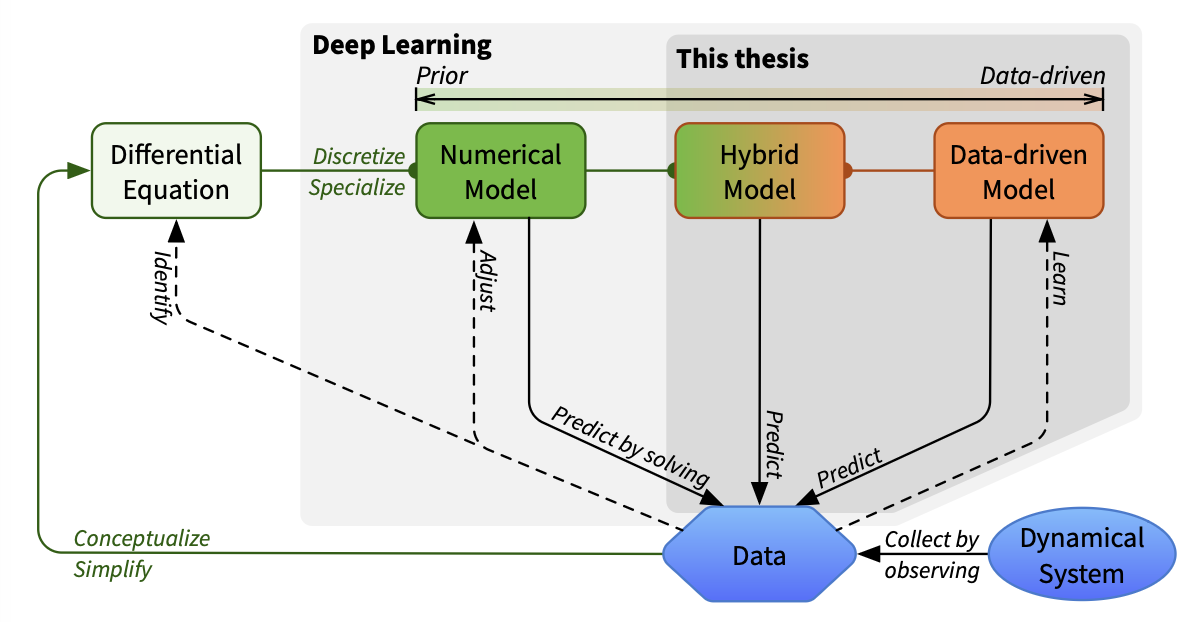
Yuan Yin received the Accessit to the AFIA IA 2024 Thesis Prize for his PhD thesis “Physics-Aware Deep Learning and Dynamical Systems: Hybrid Modeling and Generalization” supervised by Patrick Gallinari. See https://afia.asso.fr/le-prix-de-these-afia/.
Deep learning has made significant progress in various fields and has emerged as a promising tool for modeling physical dynamical phenomena that exhibit highly nonlinear relationships. However, existing approaches are limited in their ability to make physically sound predictions due to the lack of prior knowledge and to handle real-world scenarios where data comes from multiple dynamics or is irregularly distributed in time and space. This thesis aims to overcome these limitations in the following directions: improving neural network-based dynamics modeling by leveraging physical models through hybrid modeling; extending the generalization power of dynamics models by learning commonalities from data of different dynamics to extrapolate to unseen systems; and handling free-form data and continuously predicting phenomena in time and space through continuous modeling. We highlight the versatility of deep learning techniques, and the proposed directions show promise for improving their accuracy and generalization power, paving the way for future research in new applications.
- Conference ICLRContinuous PDE Dynamics Forecasting with Implicit Neural RepresentationsIn The Eleventh International Conference on Learning Representations, ICLR 2023, Kigali, Rwanda, May 1-5, 2023, May 2023
Effective data-driven PDE forecasting methods often rely on fixed spatial and / or temporal discretizations. This raises limitations in real-world applications like weather prediction where flexible extrapolation at arbitrary spatiotemporal locations is required. We address this problem by introducing a new data-driven approach, DINo, that models a PDE’s flow with continuous-time dynamics of spatially continuous functions. This is achieved by embedding spatial observations independently of their discretization via Implicit Neural Representations in a small latent space temporally driven by a learned ODE. This separate and flexible treatment of time and space makes DINo the first data-driven model to combine the following advantages. It extrapolates at arbitrary spatial and temporal locations; it can learn from sparse irregular grids or manifolds; at test time, it generalizes to new grids or resolutions. DINo outperforms alternative neural PDE forecasters in a variety of challenging generalization scenarios on representative PDE systems.
- Conference NeurIPSOperator Learning with Neural Fields: Tackling PDEs on General GeometriesLouis Serrano, Lise Le Boudec, Armand Kassaï Koupaï, Thomas X. Wang, Yuan Yin, Jean-Noël Vittaut, and Patrick GallinariIn Advances in Neural Information Processing Systems 36: Annual Conference on Neural Information Processing Systems 2023, NeurIPS 2023, December 10-16, 2023, New Orleans, Louisiana, USA, Dec 2023
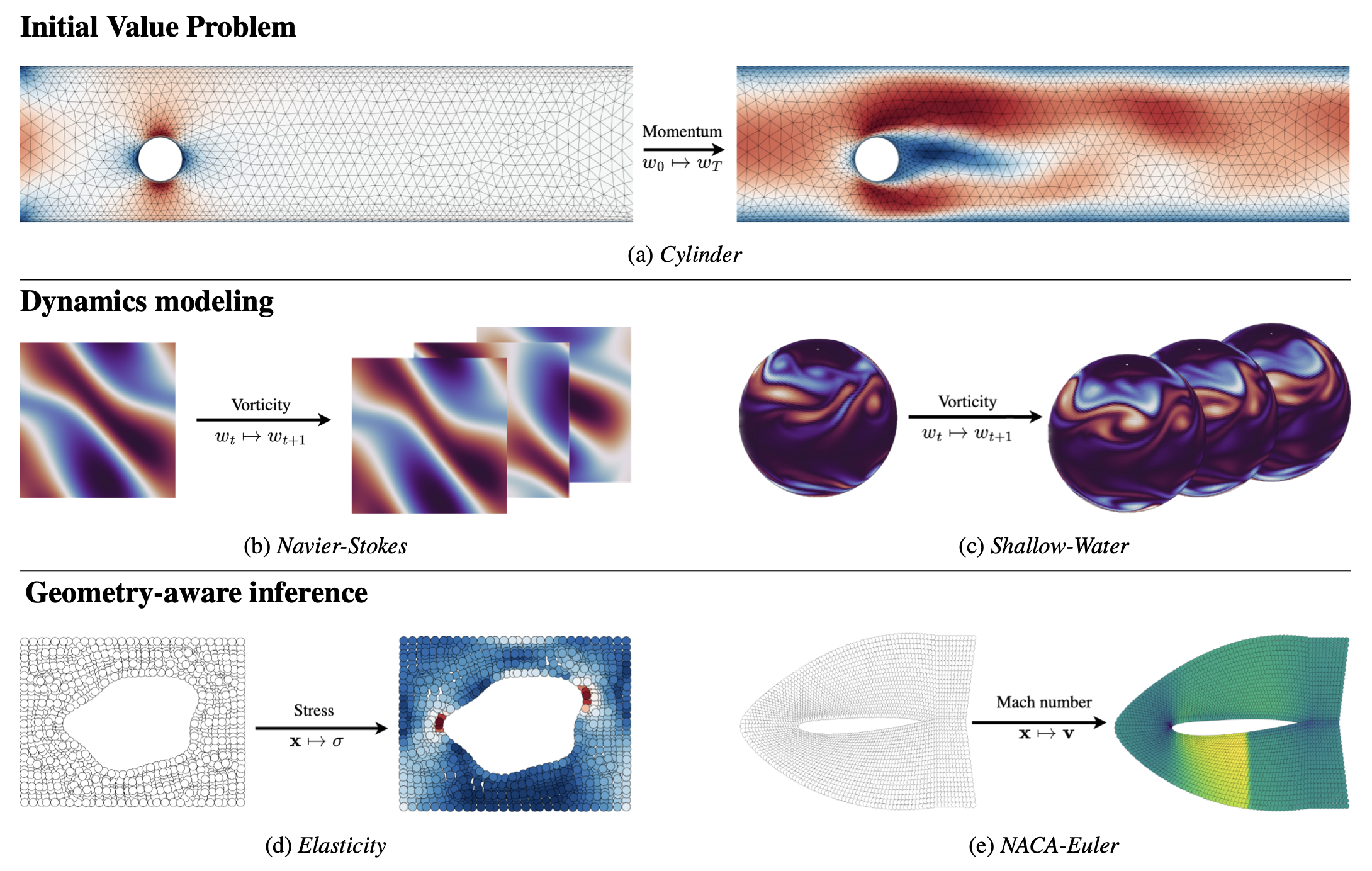
Machine learning approaches for solving partial differential equations require learning mappings between function spaces. While convolutional or graph neural networks are constrained to discretized functions, neural operators present a promising milestone toward mapping functions directly. Despite impressive results they still face challenges with respect to the domain geometry and typically rely on some form of discretization. In order to alleviate such limitations, we present CORAL, a new method that leverages coordinate-based networks for solving PDEs on general geometries. CORAL is designed to remove constraints on the input mesh, making it applicable to any spatial sampling and geometry. Its ability extends to diverse problem domains, including PDE solving, spatio-temporal forecasting, and inverse problems like geometric design. CORAL demonstrates robust performance across multiple resolutions and performs well in both convex and non-convex domains, surpassing or performing on par with state-of-the-art models.
- Conference ICMLGeneralizing to New Physical Systems via Context-Informed Dynamics ModelMatthieu Kirchmeyer*, Yuan Yin*, Jérémie Donà, Nicolas Baskiotis, Alain Rakotomamonjy, and Patrick GallinariIn International Conference on Machine Learning, ICML 2022, 17-23 July 2022, Baltimore, Maryland, USA, Jul 2022
Data-driven approaches to modeling physical systems fail to generalize to unseen systems that share the same general dynamics with the learning domain, but correspond to different physical contexts. We propose a new framework for this key problem, context-informed dynamics adaptation (CoDA), which takes into account the distributional shift across systems for fast and efficient adaptation to new dynamics. CoDA leverages multiple environments, each associated to a different dynamic, and learns to condition the dynamics model on contextual parameters, specific to each environment. The conditioning is performed via a hypernetwork, learned jointly with a context vector from observed data. The proposed formulation constrains the search hypothesis space to foster fast adaptation and better generalization across environments. We theoretically motivate our approach and show state-of-the-art generalization results on a set of nonlinear dynamics, representative of a variety of application domains. We also show, on these systems, that new system parameters can be inferred from context vectors with minimal supervision.
- Conference NeurIPSLEADS: Learning Dynamical Systems that Generalize Across EnvironmentsIn Advances in Neural Information Processing Systems 34: Annual Conference on Neural Information Processing Systems 2021, NeurIPS 2021, December 6-14, 2021, virtual, Dec 2021
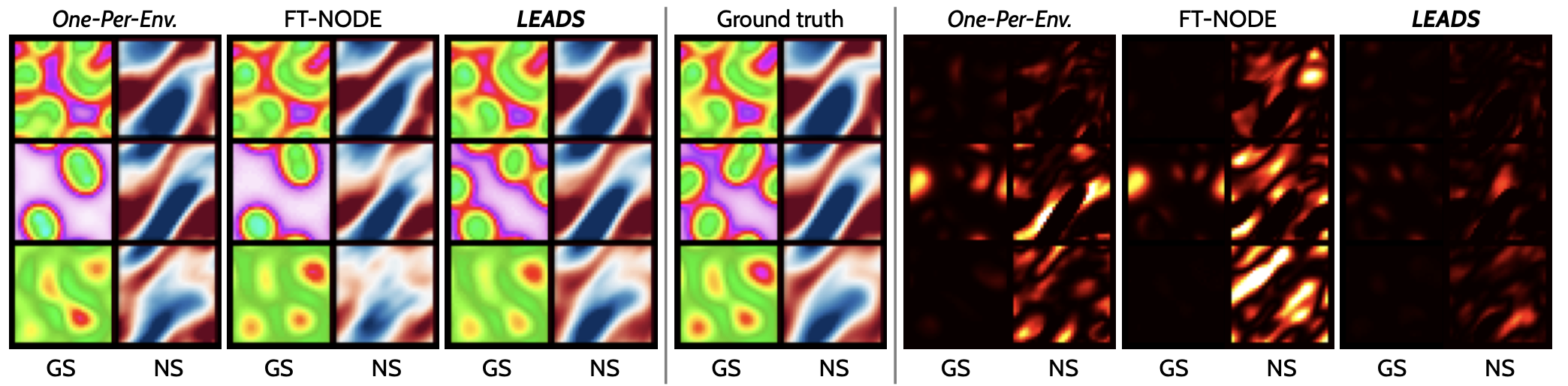
When modeling dynamical systems from real-world data samples, the distribution of data often changes according to the environment in which they are captured, and the dynamics of the system itself vary from one environment to another. Generalizing across environments thus challenges the conventional frameworks. The classical settings suggest either considering data as i.i.d. and learning a single model to cover all situations or learning environment-specific models. Both are sub-optimal: the former disregards the discrepancies between environments leading to biased solutions, while the latter does not exploit their potential commonalities and is prone to scarcity problems. We propose LEADS, a novel framework that leverages the commonalities and discrepancies among known environments to improve model generalization. This is achieved with a tailored training formulation aiming at capturing common dynamics within a shared model while additional terms capture environment-specific dynamics. We ground our approach in theory, exhibiting a decrease in sample complexity with our approach and corroborate these results empirically, instantiating it for linear dynamics. Moreover, we concretize this framework for neural networks and evaluate it experimentally on representative families of nonlinear dynamics. We show that this new setting can exploit knowledge extracted from environment-dependent data and improves generalization for both known and novel environments.
- Conference ICLR + Journal JSTATAugmenting Physical Models with Deep Networks for Complex Dynamics ForecastingYuan Yin*, Vincent Le Guen*, Jérémie Donà*, Emmanuel de Bézenac*, Ibrahim Ayed*, Nicolas Thome, and Patrick GallinariIn 9th International Conference on Learning Representations, ICLR 2021, Virtual Event, Austria, May 3-7, 2021, May 2021
Forecasting complex dynamical phenomena in settings where only partial knowledge of their dynamics is available is a prevalent problem across various scientific fields. While purely data-driven approaches are arguably insufficient in this context, standard physical modeling based approaches tend to be over-simplistic, inducing non-negligible errors. In this work, we introduce the APHYNITY framework, a principled approach for augmenting incomplete physical dynamics described by differential equations with deep data-driven models. It consists in decomposing the dynamics into two components: a physical component accounting for the dynamics for which we have some prior knowledge, and a data-driven component accounting for errors of the physical model. The learning problem is carefully formulated such that the physical model explains as much of the data as possible, while the data-driven component only describes information that cannot be captured by the physical model, no more, no less. This not only provides the existence and uniqueness for this decomposition, but also ensures interpretability and benefits generalization. Experiments made on three important use cases, each representative of a different family of phenomena, i.e. reaction-diffusion equations, wave equations and the non-linear damped pendulum, show that APHYNITY can efficiently leverage approximate physical models to accurately forecast the evolution of the system and correctly identify relevant physical parameters.